The Pulpit Fixation

Gospel preaching and heralding is so important; yes, central to church life and mission. “Thus says the Lord” (the kerygma) proclamation is unmatched in any other practice of the church. Men do well to study and refine both their art and skillset for better communication and captivating messages of grace.

However, there is a fixation with the “pulpit” that is counter-productive to church life. The hindrance comes when men focus so heavily on the pulpit-as-all-central to the exclusion of the practice of Christian community. We need to emphasize here that it is the Christian community which is called to live-out all of the finely delivered sermons they receive. Truly, the church body needs the preached Word but it also needs the gifts operating throughout the bride. Are we being careful so as not to make an enemy out of the practice of Christian community to seek validation for our preaching?

A pulpit-only ministry has two problem areas to start with. First, it communicates there is one person (or a few) who has all the gifts you need. Second, it pits the practice of the Word against the listening to it. In a brief amount of time, you will have frustrated and unfulfilled sheep because they have no avenues to practice the one-anothers nor missional outreach. Good messages will turn from captivating to aggravating due to the guilt of sitting on so many spoken truths. We need both the spoken and the embodied Word. It should not be an either-or scenario.

 

Podium


Note: coming next – “the meeting fixation” – which deals with the idea of groups meeting without biblical intentionality. 
7 Lessons of Gospeltality

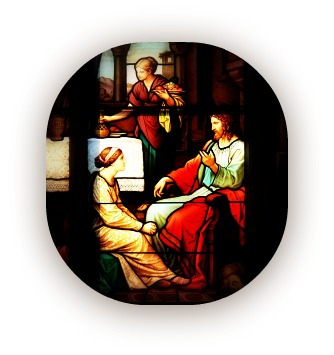
Jesus is invited to a meal where he takes the opportunity to disciple two sisters in hosting and communing. The story is found in Luke 10:38-42 just before he trains his disciples to pray. The intent of the passage is to have both sisters banqueting at the feet of Jesus. In this case, however, the quiet and resting Mary acts as a foil to her agitated and busy sister, Martha. And that is where we see the discipleship lessons of Jesus coming into play. The presence of the Good News (Gospel) coupled with the activity of teaching and training in a meal setting (hospitality) is where we combine the words to get Gospeltality. On a lovely side note, isn’t it great that Jesus is discipling women and also how he disciples them through their home and everyday lives? By doing it this way, Jesus went beyond the cultural norms (women weren’t discipled) and did it so that it wouldn’t be scandalous to others (informally at a meal setting). 

Our gratitude goes out to Sister Martha who represented us so well. We needed these discipleship lessons:

  1. We need to make sure that we understand who the host is correctly. Jesus said in verse 42, “…this one thing is necessary…” He is the one thing.
  2. We need to understand what is being hosted. The bigger picture of Jesus is why we serve. He is the living meal of God; the one, good portion that will never be taken away.
  3. We need to get our attitude right about our circumstances. If the presence of Jesus is there, then we need to recognize it and rest at his feet.  
  4. We need to forsake the kind of hosting that gives pride to our cooking, cleaning, and homes (our stuff). Otherwise, that will become all that we are about.
  5. We need to help people interact with Jesus. People should be able to see and hear Jesus when they intersect with our lives. If Martha doesn’t learn this, people will always see her. Mary got it.
  6. We need to give-way to Jesus to do his ministry in our every-day world.
  7. We need to allow the marginalized to host us. Jesus came to his own and was unwelcome (Jn. 1:11-12). There were plots to kill him. Jesus had no home, and he was poor. He also made himself the marginalized King by leaving heaven to be the friend of the broken and the least. And so, Jesus says, “as you did it to one of the least of these my brothers, you did it to me.” (Matt. 25:40).  We have so much to learn from those who are on the outside. We also have a great opportunity to be humble because we will be constantly surprised how Jesus enters our homes and our worlds. If Jesus doesn’t host us, we will always be the host, rival him, and make ourselves superior to others.

Martha3

A Great Definition of Accountability

The Apostle Paul writes to some of his life’s best friends — the loving, supporting believers of Philippi. And he says to them in chapter 1:

7 “It is right for me to feel this way about you all, because I hold you in my heart, for you are all partakers with me of grace, both in my imprisonment and in the defense and confirmation of the gospel.

8 For God is my witness, how I yearn for you all with the affection of Christ Jesus.

9 And it is my prayer that your love may abound more and more, with knowledge and all discernment,”

There are a lot of deep “connection phrases” there in those verses (ie. hold you in my heart, you are partakers with me, I yearn for you with all affection etc. ) What I see Paul describing is a rich, mutual sharing where each party has each other’s best interests in mind. They really like and love each other. The Philippians want Paul to flourish, and Paul wants the same for them.

They are deep, spiritual friends. Only friends who know that other friends have their best interests at heart will open themselves accountably.

Therefore, accountability is spiritual friendship operating at its very best.

Lord, Do You Not Care?

Luke 11:40

But Martha was distracted with much serving. And she went up to him and said, ‘Lord, do you not care that my sister has left me to serve alone? Tell her then to help me’.”

The way that Martha asks this question reveals her attitude in coming to this meal of grace with Jesus. When she says, Lord do you not care? She is expecting a positive response. We can catch this sense of irritation in her question, “It’s obvious that I’m justified in how I feel and how I’m viewing this situation! You do care, don’t you?” In Greek, the way the word ‘not’ is placed in the sentence gives us this clue, “Do you not care?!”

That’s a tough one to answer. When an irritated woman is about to serve a meal and asks me, “Do you not care…?!” I don’t think I would answer like Jesus did. I strive not to have fear of man issues, but I haven’t gotten so far with fear of woman issues. My immediate reaction would be, “Why yes, I do care!” Then, I would stand up, move toward the kitchen, look at the other guys sitting around and say, “Don’t you care? Look at you just sitting there… pathetic.” Or something similar.

Darrell Bock in his commentary on this passage says, “As is often the case when Jesus is asked to settle a dispute, he refuses to side with the one who asks that things be decided in a particular way (compare Lk. 12:13, Jn. 8:4-7).” [Luke, pg. 201] So, Jesus himself does not get up, neither does he tell Mary to rise up and help.

Instead, Jesus warmly says, “Martha, Martha…” because he is training his disciple and friend to eat the greater meal. Martha will always have this “service chip” in her attitude unless Jesus saves her from it. People will not see Jesus or the Gospel through her hard work, because it will always go back to her. Her hospitality has to be trained to point to the greater host. It would literally be better if they didn’t eat (temporarily, until the host was ready). There was a better meal to be had.
See? Jesus does care.

Martha4


Rival Hosting 2: Stressed-out Martha

Luke 10:38-42

Martha is anxious and troubled about many things, says Jesus. Here’s my question,
What does she have to be troubled about?

There’s no dishwasher, no microwave, no playlists to queue, no cellphones ringing, no status to update that she’s “…cooking for the King of kings. How about you?” Copy. Tweet. Like.

She’s not taking pictures, chasing toddlers, or printing out a new recipe. The floors are made of hardened clay so they’re naturally a bit dirty. She has a simple broom, but no vacuum and the broom is faster anyway in such a small house. She doesn’t have dish soap, so it’s always rinse cycle and there’s a certain relaxing bliss to being ignorant about germs. The furniture and utensils are simple so she’s not using her fine China. Can she even find China? It doesn’t matter because their internet connection is perpetually down so there’s no stream of superfluous information. And she’s not living in the Age of Distraction, but Martha is inventing multi-tasking which hasn’t even been named yet.

How many things could she possibly have to be so stressed-out about?

If Martha, being so troubled by the simple stuff of life-back-then, were living today — she would implode. She would never make it! Give our world a try, Martha!

All the more desperation is necessary, therefore, to recover the life-rhythm of allowing Jesus to host his Gospel of grace through our homes. If it happened to Martha back then, I don’t think we are better-off now.


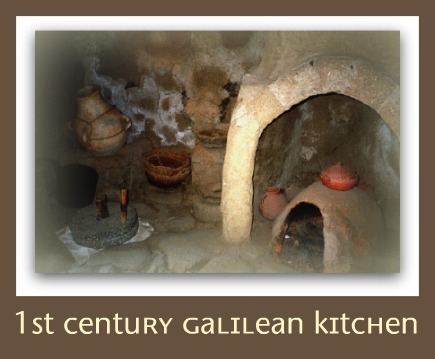
Galilean_kitchen
note: for more information about this picture and Galilean kitchens, click here.


Rival Hosting

Martha, the anxious hostess, invites Jesus the Kingdom-host to come into her home. She wants him to be around her house, but she’s not yet ready to surrender her life to him. Martha craves the admiration and affirmation of a powerful Rabbi. Instead, the events start to turn against her will and she breaks-down into anxious anger.

Galilean_family_room

What’s really happening is a small power struggle; a rivalry of hosting. Martha is in her “every-day-world” where she is queen; it’s her home. Hosting is where Martha shines. And like all of us, home is where “Martha is Martha.” The plot thickens when Martha invites the King into her world who is at home in all of his world. Who should impress who? Which one should host the other?

A quick discipleship lesson we can learn is that we can’t rival the host where it matters the most — in the center of our everyday lives, or what we call home. Otherwise, our homes can never be gospel homes. Jesus hosts, or we do.

Luke 10:38-42


note: for more information on this interesting photo and a Galilean family room, click here.

Food and Ministry: Problem 3

Ghanaian_food

I don’t even know how to spell it, but it sounds like “watch-it” and our Ghanaian church family members were excited about it. I’ve had Fufu, tasted red-red, and enjoyed plantanes & rice but watch-it was new. For weeks, we had been talking about our inter-cultural meal (read: awesome potluck) that we were planning and they wanted me to try their favorite dish. The day came. Their enthusiasm was high along with my anticipation — and the first bite…. well … ya …  I had to watch-it. It was completely foreign to me; an acquired taste in the making.

As I was working my way through that first bite, one of the brothers said, “Pastor, I like it with piccante sauce.” My eyes lit up as I mumbled through my watch-it, “Hmm…ya… div-me-thum-o-that … hmm… lots…ya… kee-it-comin.” Then, our dear sisters asked me, “Pa-pa, do you like it?” To which we westerners all respond, “It’s different, a bit unexpected.” And then they had a good laugh. 

So, would I eat watch-it again? Yes, because I like my brothers and sisters much more than I like the dishes that appeal to me. You might be saying, “But, it didn’t appeal to you!?” And you’re right. The dish appealed to them, and so it is part of their joy and identity. If I don’t watch-it, I’ll miss the ministry to the Africans because I’m only comfortable with the food of the Italians. 

Problem #3: Culture Comfort

Culture comfort with our food basically says that I’m not willing to try food that isn’t what I’m used to. The point is not just to try different, international foods but to see who those foods are connected to. A good bit of a person’s identity is wrapped up in their food. It is like a chain of links. If you reject someone’s food or type of food, you reject their culture. If you reject their culture, then you reject a part of them. 

Ministry Impact

Over the years of eating and ministry, we have noticed that more of our African brethren struggle with this problem. What happens when we concentrate on eating only the foods that are comfortable to us is that we communicate that we are just fine with keeping exclusively to ourselves. We actually begin to close down our thinking toward other groups of people and we strive to maintain our own cultural identity even more. Through the different “tastes” of food that we don’t like, we start to think of the people in this way too. We will say things like, “I don’t understand them” and we will seek to avoid the awkward experiences again. Therefore, even how we eat and share our food will stop being missional. Once we build our comfort zone, we will see others as invaders in our lives and not included. Then, to protect our comfort zone and identity, we will have to sneer at the intrusions or sneak away from them. 

Recommended Solution:

Try different foods that people make and offer you. Try the plates for the people. Go missional with food and see those tastes as gateways into people groups. Train yourself to be open to others and their cultures through food. Watch-it on purpose.

Food and Ministry: Problem 2

Jesus_feet_house_of_simon

“I entered your house; you gave me no water for my feet…You gave me no kiss…You did not anoint my head with oil…he who is forgiven little, loves little.” Jesus (Luke 7:44-47)

How we conduct our meals and share our food does reflect on how we practice and give the Gospel. The passage above is from the account where Jesus is invited to Simon’s house. In the end, Simon does not have the good news of forgiveness (his meal conduct illustrated that), and Jesus does have the good news of love and forgiveness (his meal character revealed that). Both how we eat and who we eat with are ministry practices of grace.

Problem #2: Food-Pride

What’s the last meal that you sat down to that left you saying, “Hmm, that just wasn’t all that good?” The last meal like that which I can remember had chicken involved — I think it was chicken (kind of tasted like chicken). Now, I can whip up a great bowl of cereal or a tasty bag of chips, but cooking isn’t my forte. Eating is my forte. I’ve studied and practiced it for many hours over the course of many years. And, living in Italy is like eating in the big leagues. 

However, one hindrance in utilizing our food for ministry that I’ve encountered is that of a certain food-snobbery. The Italian kitchen does have bragging rights. Each region merits an appreciation for how it takes every-day ingredients to a whole new level. But when it is made evident at a meal that the pasta wasn’t cooked to the optimum consistency or a certain sauce lacks an ingredient or the after dinner coffee just doesn’t have the taste like mamma mia’s coffee — we are entering the realm of personal acceptance and gracelessness

Ministry Impact

Through the years of ministry, we have noticed that more of our Italian brethren have struggled with this problem. What happens when we concentrate on the standard of the food is we are communicating that we are just there for the superiority of our culture. Often, the message is subtle but it is there that you are not one of us. Anybody can practice this when they take too much pride in the food they have prepared and how they have prepared it. A meal that shares the ministry is one of inclusion. As Christians, we need to communicate that our table is open. Grace shows favor, welcome, appreciation, and forgiveness (pretty much like Jesus). Using food as an instrument of pride shows exclusivity, superiority, and how to be a jerk (pretty much like Simon).

Recommended Solution:

We should humble ourselves before others — through food. This means allowing the food to be what it is. If food becomes the focus, then simpler is better here or we will really close the doors on future opportunities to bring friends to Jesus because we want them to praise us first.

See the meal as a means of acceptance and of being equals at a table. The Christian church is greater than any one culture and our tables can model that. Talk more about the qualities of the persons at the meal than the qualities of the recipes and ingredients of the meal. Enjoy the people God has made more than the food or how it has been prepared.


Food and Ministry: Problem 1

Continuing on with this small series of food & grace

How we practice our meals, eat together, and share our food are all reflective of how we are striving to reach out to others and to cross-over to different cultures with the Gospel. Quite often, these efforts will also reveal where we are missing something in our understanding or lacking in a certain area of grace.

Problem #1: Slowing Down

I’ve had a breakthrough! Through the years, I’ve been criticized for being a slow-eater. But now! Now, I’ve realized that I’m a normal-eater being chided by hyper-fast eaters. It turns out, my eating pace is just right for where I live — viva l’Italia! Not only do I feel better; I feel vindicated. Food-justice has been served.

Four hours of cooking and fourteen minutes of eating. Ever experienced that? And, when there’s not time to cook, four minutes of cooking for the same fourteen minutes of eating. It’s called fast-food for a reason. Seriously, you can’t take or have communion in a drive-through. We might as well call it fast-fuel because that’s how we’re using it.

Ministry Impact

Through the years of ministry, we have noticed that more of our American brethren have struggled with this problem. What happens when we eat quickly is we are communicating that we are just there for the food. Relationships take time, and relationships can be forged through mealtimes. However, if we don’t utilize our food as a means of grace to bless others, we are communicating that we’re at the table for our own agenda and we need food to get that done. Slowing down will naturally keep us at the table for others.

When food is a gracious ministry tool, we strive to share in an experience with one another and to practice Christian community. If our habit is to eat-and-run (done with our shared experience within 30 minutes), we really miss out on a great deal of ministry opportunity that comes from spending more than an hour together.

Recommended Solution:

I highly recommend sharing meals together in courses. Italia has a great model for this: start with appetizers (antipasti), then firsts (i primi), seconds (i secondi), sides (contorni), and sweets (i dolci — don’t ever forget this one!). Variations are fine. Remember, it’s not about the quantity of food more than it is the quantity of time. Courses help to slow things down which will provide more opportunities to nurture things that last — our souls.

—–
Two more problems to come…I’ll try to spill the beans on cultural tendencies only and not mention anyone by name — maybe.

Spill_the_beans

3 Uses of Food for Ministry

We recently completed a three-week series at Serenissima entitled Major Ministry Tools. We looked at how our food, homes, and families are things we live with every day that can share the great story of the Gospel.

Here were 3 insights from the message on Food as a Major Ministry Tool.

  1. Food is not just fuel; it’s faith:  If I only regard food as fuel, then what I’m really doing is using food to fuel my own agenda instead of being nourished by it to follow the Lord’s will. Physical hunger takes me back to the table where I remember (repeatedly) that I am a dependent being. The very act of eating shows that I have to trust in provisions beyond myself. We give thanks to the Lord to recognize that He is the source of all of these provisions. Eating is our act appreciation and trust for our lives. It gives us a window on faith.

  2. Food is not just good; it’s grace: By God sharing his bounty with me to meet my need (common grace), I can share with others to point them to God through Jesus (special grace). I wrote about how food is an image of grace in our last post. In previous centuries, food was much harder to come by so it was easily hoarded. But God desires a righteous and generous people who live like He thinks. Both the act of sharing your food and the people with who you share your food is telling a story of grace. Could it be that food and hunger were both created to give us the ways to understand and re-tell this Good News?

  3. Food is not just for consumption; it’s for communion:  Jesus compared himself to food (bread & water of life). When you invite someone in to your home to share a meal, you are sitting down with them as a peer. You’re looking eye-to-eye with them and sharing in each other’s lives by allowing them to have a seat — where you are. That’s how God offered the most precious meal of Jesus, the Paschal Lamb. God invited his enemies to come through the Door of his home and sit at his lavish banquet feast and commune with him. The table of the Lord is offered to those who will turn to Jesus (ie. consume & assimilate) and commune with him.
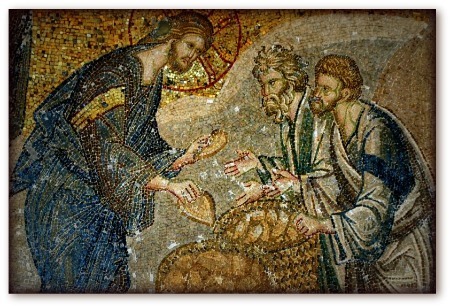
    Multiplying_loaves

Food and Grace

The Son of Man came eating and drinking but they called him a glutton and a drunk (Luke 7:34). I think they called Jesus a glutton partly because he enjoyed eating so much and the other part because they weren’t enjoying eating so much due to their frustrating fasting rites and limited mealtime company. The Pharisees had turned their food — ungracious.

Have you ever thought, “Why did God make it so that we have to sit down 2-3 (maybe 4) times a day to replenish?” One simple, primary reason is to remind us each time that we are dependent and God is gracious. Jesus created both hunger and the food that relieves hunger. As our created hunger grows, we return to a dependent state for food time and again.

Therefore, our mealtime can be called “grace-time” because the image of dependency & favor is continuously repeated. The best way to share a meal is to share both your food as grace and the One who is Grace.

We “say grace” at mealtime when we are really receiving it. Our privilege comes not just when we say grace but when we share grace.


Food__grace


The Integration Principle

Another church planting principle that we’ve noticed through the years has been that believers who are maturing in the Faith also broaden their acceptance of other people from different cultures. Whereas, in the Ingress Principle, people feel more welcome with others who are like them, this principle says that believers mature toward people who are unlike themselves. So, a church should seek to provide opportunities to integrate the cultures (that are welcoming others) into a Christ-centered, alternative culture. People usually need to be warmly-welcomed and meet Jesus before they begin to appreciate and care for others that are different than they are. At the same time, we don’t want to leave the church body to be isolated into separate cultures because the fullest expression of the Gospel will be lost and enculturated back into a certain people group.
For example, in the Ingress Principle, I mentioned a group of Chinese people who are being welcomed by a group of Germans who are believers. In time (could be long or short-term), when more Chinese people are also saved, they will come to see more of Jesus in the Germans and appreciate them as brothers and sisters. This will happen not just because they’re Germans, but because they are of Jesus. They will have a deep appreciation for the Germans because the Germans originally showed them the love of Jesus. So then, we want the Chinese to be together with the Germans so that, altogether, they can simply be Christians in God’s family. These principles of welcoming (ingress) and maturing (integration) will repeat themselves through the joy of outreach and evangelism.